2025’s Lunar Pivot: Private Landers, Cellular, and Navigation
Two private landings, the first cellular network on the Moon, and a working lunar satnav demo turned 2025 into a year of operations, not experiments. See how CLPS changed pace and what to watch through 2027.

The year the Moon went live
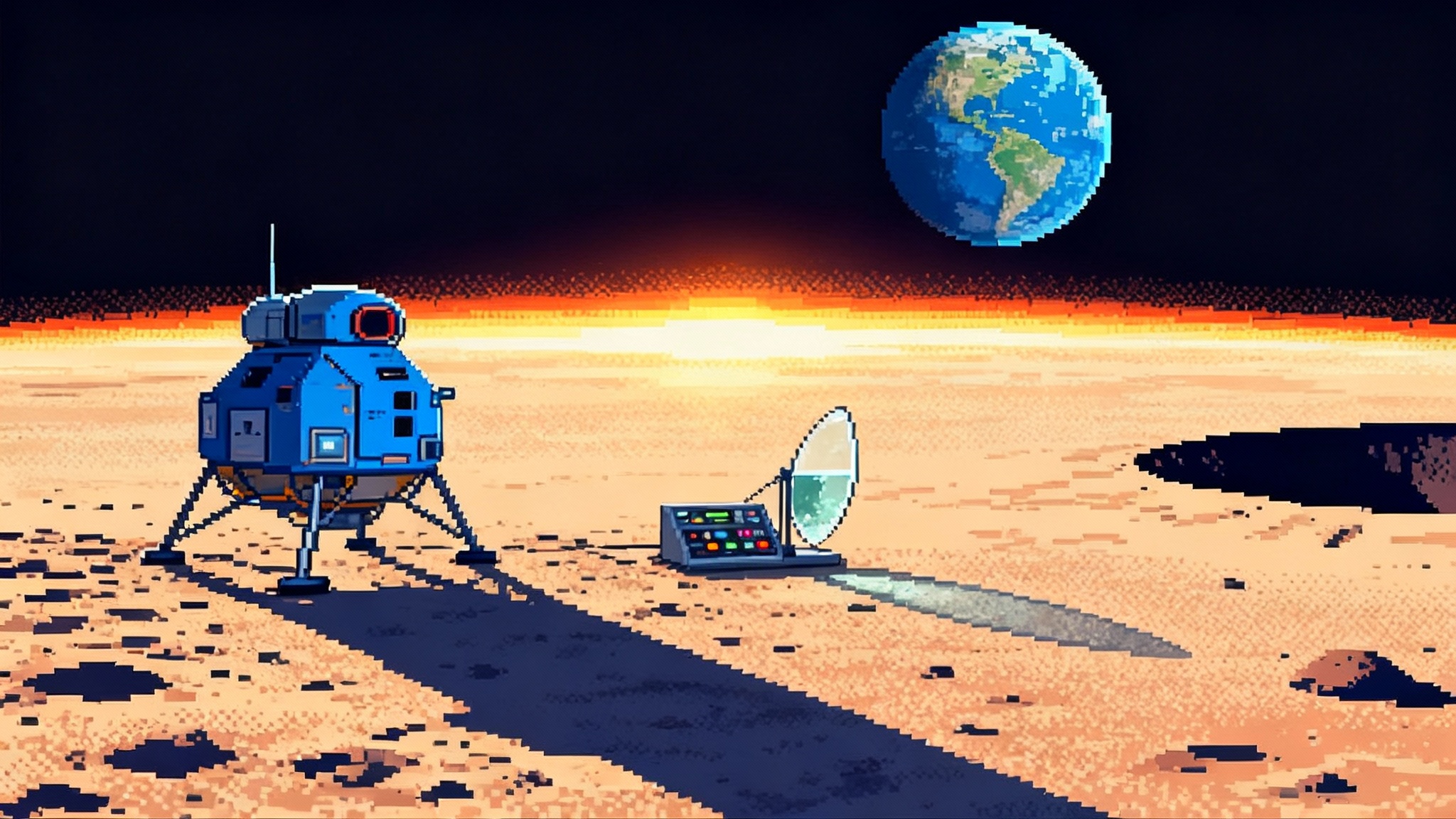
In the space of two early-spring weeks in 2025, the Moon crossed an invisible line. Firefly Aerospace’s Blue Ghost Mission 1 touched down in Mare Crisium on March 2 and worked through the lunar day. A few days later Intuitive Machines’ Athena lander for IM-2 reached the south-pole region, and even though the craft came to rest on its side inside a crater, it powered a small but historic first for surface communications. Nokia’s team confirmed that the company’s compact “network in a box” turned on, came on air, and transmitted operational data during a brief power window, establishing the first cellular network delivered to the lunar surface, as Nokia’s post-landing update documented.
Milestone fatigue is a risk in any fast-moving field, so it helps to state plainly what changed. In 2024, Commercial Lunar Payload Services, or CLPS, was still proving that private landers could reach the Moon at all. In 2025, CLPS began acting like an operating line of service: deliveries arrived, instruments switched on, networks came up, and data flowed. Not everything worked perfectly, but enough worked in real environments that planning shifted from prototypes to procedures. Meanwhile, sample-return insights continue to reframe lunar context, as shown when Chang'e-6 rewrites the Moon: older basin, drier far side.
CLPS, from experiments to operations
When CLPS began, it was a bet that buying deliveries would be faster and cheaper than building NASA landers for every instrument. In practice, 2025 turned the bet into an operating model. The difference shows up in the cadence and the character of the work:
- Payloads were integrated for specific jobs, not just tech tasting menus. Blue Ghost carried a suite that attacked known blockers to polar operations, from dust to navigation.
- Teams practiced contingency playbooks. IM-2’s off-nominal posture meant power was scarce, yet mission control sequenced through time-critical tests, including the cellular demo and initial activity from NASA’s volatiles suite, before declaring end of mission.
- Providers delivered measurements with clear downstream users. This matters because it shifts follow-on funding from “science project” to “service contract.” This same shift from one-off demos to pipelines echoes trends like Rubin’s year of fast discovery.
Think of CLPS in 2025 as a municipal utility coming online in a rough frontier town. Power blinks, water pressure is patchy, and the roads are dusty. Yet homes are being connected, meters are spinning, and the crews now have addresses and work orders, not just maps and dreams. We have seen similar transitions in Earth orbit as HTV-X1 rewired space cargo, where experimental flights matured into dependable logistics.
What a Moon cell network really is
A cellular network on the Moon conjures images of astronauts placing calls from a crater rim. The reality is more focused, and more useful. Nokia’s Lunar Surface Communications System is a compact, ruggedized radio, base station, and core network packaged to run on a lander with minimal power. In the short window when Athena’s panels could feed it, the system turned on, went on air, and exchanged telemetry with Earth. In plain terms, the team proved that terrestrial cellular technology can be hardened for the Moon, brought up on cue, and managed remotely under harsh thermal and power constraints.
Why that matters: standardized radios and protocols reduce mission integration time. If rovers and instruments can ship with commercial off-the-shelf radios tuned for lunar bands and services, surface networking stops being a bespoke engineering task and becomes a line item. The obvious next steps are longer power windows, broader coverage footprints, and handover between nodes so that rovers can roam.
IM-2 also illustrated a harsh truth about polar operations. Landers at low sun angles live and die by panel orientation, shadowing, and thermal soak. A network node that is alive for minutes is still a breakthrough, but the path to robust service runs through better siting, more forgiving power architectures, and relay support that does not depend on a single panel catching the light.
The first satnav fix on the Moon
The second quiet revolution was navigational. NASA and the Italian Space Agency flew the Lunar GNSS Receiver Experiment, or LuGRE, on Firefly’s Blue Ghost lander. In the early hours of March 3 Eastern time, LuGRE acquired and tracked signals from United States Global Positioning System satellites and Europe’s Galileo constellation and computed a position fix on the lunar surface. Those signals are extremely faint at lunar distance, subject to geometry unlike what phones see on Earth, and embedded in a radio environment shaped by a lander’s structure and the local terrain. Yet the system locked on and solved for position, velocity, and time. NASA called it the first lunar Global Navigation Satellite System fix, a data point that will inform real operational receivers for future missions, per NASA’s LuGRE acquisition report.
Why it matters: if a lander or rover can autonomously determine its position without waiting for Earth-based tracking, surface operations can be faster, safer, and less labor intensive. Imagine the difference between hiking with a map and compass while calling a friend for landmarks, versus having a working trail app that shows where you are relative to hazards and goals.
This result also ties into LunaNet, the joint architecture that NASA and European partners are developing so lunar users can get continuous communications and positioning fixes. LuGRE proves that Earth’s navigation signals can be part of the mix. Fold in lunar relay satellites and surface beacons, and you have the beginnings of Global Navigation Satellite System on the Moon, not by launching a separate full constellation, but by augmenting what already exists and stitching it together with lunar-specific services.
Dust is the enemy, and 2025 showed countermeasures that work
Apollo taught everyone that lunar dust is abrasive, electrostatic, and merciless. It jams mechanisms, degrades radiators, blinds cameras, and clings to suits. Blue Ghost carried two complementary dust payloads with an operational bent. One was a regolith adherence characterization package that exposed common materials and coatings to the landing plume and day-to-day dust, then measured what stuck and how fast. The other was NASA’s Electrodynamic Dust Shield, a set of surfaces that use controlled electric fields to lift and shed dust without moving parts. By late March, NASA reported that the shield worked on the Moon, clearing glass and radiator samples after they were deliberately fouled.
These are not academic exercises. A camera that cleans itself and a radiator that sheds dust extend mission life. A visor or viewport that can be pulsed clean removes a failure mode that otherwise requires precious crew time and consumables. The key in 2025 was not that we invented dust mitigation, but that we showed methods that can be built into flight hardware and operated on a schedule.
Prospecting turns into procedure
At the south pole, resource prospecting is the difference between occasional visits and sustained activity. IM-2 carried NASA’s Polar Resources Ice Mining Experiment 1, a drill and mass spectrometer pair designed to bring subsurface grains to the surface and sniff for volatile compounds such as water and carbon monoxide. The lander’s posture and power constraints limited how long PRIME-1 could operate, but mission control still advanced the script, deployed hardware, and began data collection before the vehicle went silent. That matters because prospecting is a process. Crews need recipes they can run and repeat: where to place a drill, how deep to go, how to keep cuttings cold, how to manage thermal flows in cryogenic soil, and how to log and interpret the gas signatures that result. 2025 delivered steps in that playbook.
The bigger unlock: robust polar communications
Polar operations are brutal for line-of-sight. Ridges and crater rims block views to Earth, and the Sun skims the horizon. The path to resilience has three pieces:
- Surface nodes that can survive cold traps and pass data locally. Nokia’s demo showed that commercial cellular technology can be adapted; next versions need better thermal margins, energy storage, and antenna placement tuned for rough terrain.
- Orbiting relays that see into craters and down to the horizon. These are the backbone of continuous coverage, much like a cell tower that never loses line-of-sight because it is looking down from above. They will also carry navigation payloads that broadcast lunar-specific timing and ranging signals.
- A network architecture that lets missions sign on and move data and timing across providers. LunaNet is the scaffolding, essentially an interoperable set of rules so that a rover with a standard terminal can call for service, authenticate, pass data, and receive positioning fixes, regardless of which commercial or agency relay is overhead.
If you want a litmus test for when the south pole becomes truly operational, watch for routine handovers between a surface node and an orbiter, with a rover maintaining a session while driving in and out of shadow.
What GNSS on the Moon changes next
LuGRE was a proof of concept. Turning it into a service will look familiar to anyone who works with satnav on Earth, with lunar twists:
- Augmented signals. Orbiting relays can carry Lunar Augmented Forward Signals, broadcasting timing and navigation tailored to lunar users, so a receiver can blend Earth GNSS and lunar augments for high confidence fixes.
- Time standards. Navigation and networking depend on shared, stable time. Expect NASA, the European Space Agency, and industry to converge on a lunar time scale that is interoperable with Earth standards but usable on the surface and in orbit.
- Terminals. A combined communications and positioning terminal that weighs kilograms, rides on a rover, and works in polar nightside cold will be a small revolution. It will collapse today’s tangle of radios and clocks into one box that crews can carry and swap.
The practical outcome is autonomy. A lander that knows where it is can pick better paths down. A rover that knows where it is can plan routes that avoid power-killing slopes. A person on the surface can navigate without a chorus of ground controllers.
Dust, power, and the art of staying alive
The hard lessons of 2025 have a common theme. The Moon does not gently hold landers at the south pole; it tips them into shadows and pulls heat out of their electronics. Survival is engineering discipline made local:
- Thermal design that treats cold traps as the default, not the edge case.
- Power systems that expect misalignment and still deliver a day of operations.
- Surfaces, joints, and optics designed for self-cleaning with minimal moving parts.
If you build those into the first drafts of a mission, everything else gets easier. Networks come on air more often. Drills run longer. Navigation receivers have the dwell time they need to lock and stay locked.
Milestones to watch in 2026-2027
The next two years should turn 2025’s firsts into routines. Here is a focused watchlist with why each milestone matters:
- Intuitive Machines IM-3 at Reiner Gamma in 2026. Objective: demonstrate repeatability of commercial landing and operations at a new site, and field a second generation of payload integration and power management. Watch for improvements in landing precision and early surface checkout speed.
- Additional CLPS south-pole deliveries through 2027. Objective: broaden the instrument mix for polar science and technology. Watch for a second cellular node, longer on-air times, and the first demonstration of data handover to an orbiter.
- LunaNet and Lunar Communications Relay and Navigation System procurement steps. Objective: lock in orbiters and standards for continuous polar coverage. Watch for contract awards for relay services and for standard user terminal specs that vendors can build against.
- Artemis hardware flow. NASA has targeted an April 2026 window for the crewed lunar flyby known as Artemis II and mid-2027 for Artemis III, the first south-pole landing of this era. Objective: align commercial deliveries with the human landing system and surface mobility elements so astronauts arrive to tested communications, navigation, and dust mitigation.
- Dust technology in mission designs. Objective: see Electrodynamic Dust Shields and dust-tolerant coatings baselined in radiator panels, camera windows, and visor concepts. Watch for teams to publish maintenance procedures that assume routine self-cleaning.
- GNSS on the Moon from demo to service. Objective: publish performance targets for lunar receivers, fly the first augmented navigation signals on orbiters, and demonstrate multi-source fixes on a rover in motion. Watch for the first combined communications and positioning terminal to ship as a standard CLPS payload option.
Each of these has a crisp success condition that is easy to recognize from the outside. That is how you know the field is maturing; you can grade progress without a decoder ring.
What this unlocks for 2028 and beyond
By 2028, if the above plays out, the south-pole story reads differently. A rover drives downhill into a crater while its operator rides out a seamless handover from a lander-mounted cell node to a polar relay. The rover maintains a navigation fix that blends Earth GNSS and lunar augments. Dust on its camera window is cleared by a pulsed surface. When the drill begins to bite, the team already knows the power budget, the thermal setpoints, and the interval for gas sampling because those procedures were refined in 2025 and 2026 on uncrewed deliveries.
That is the real meaning of this year’s pivot. We did not just land. We began to standardize how to live and work.
A reader’s checklist for the next launch
- Does the mission publish a clear power and thermal plan for polar angles and shadowing, with contingency for off-nominal posture?
- Is there a surface network node and a plan for on-air duration, antenna placement, and handover to an orbiter?
- Are navigation receivers specified to use both Global Navigation Satellite System signals from Earth and lunar augments, with stated accuracy targets?
- Which dust countermeasures are baselined, and where are the self-cleaning surfaces?
- For volatiles, what is the exact drill depth, sample handling method, and gas analysis timing, and how will data be shared with follow-on users?
If a mission answers those with specifics, you are looking at operations, not experiments.
The bottom line
In 2025, the Moon became a place where private companies could deliver, switch on, and learn fast under real constraints. A lander brought a cellular network on air, another proved that satellite navigation can work one quarter million miles from home, and dust defenses ran on schedule. That is enough to claim a turning point. The next test is repetition. When landers arrive and crews plug into a service menu that includes communications, navigation, and dust control, sustained south-pole activity stops being a slogan and becomes logistics. That is the moment to watch, and, if 2025 is a guide, it is coming into view.