Ghost Shark Goes Fleet: Australia Bets on XL-AUVs Now
On September 10, 2025, Australia moved from prototypes to production with a multi-year Ghost Shark XL-AUV fleet. Here is how mass, long-range autonomy could reset deterrence and sea denial across the Indo-Pacific by 2026.

The breakthrough Australia just made
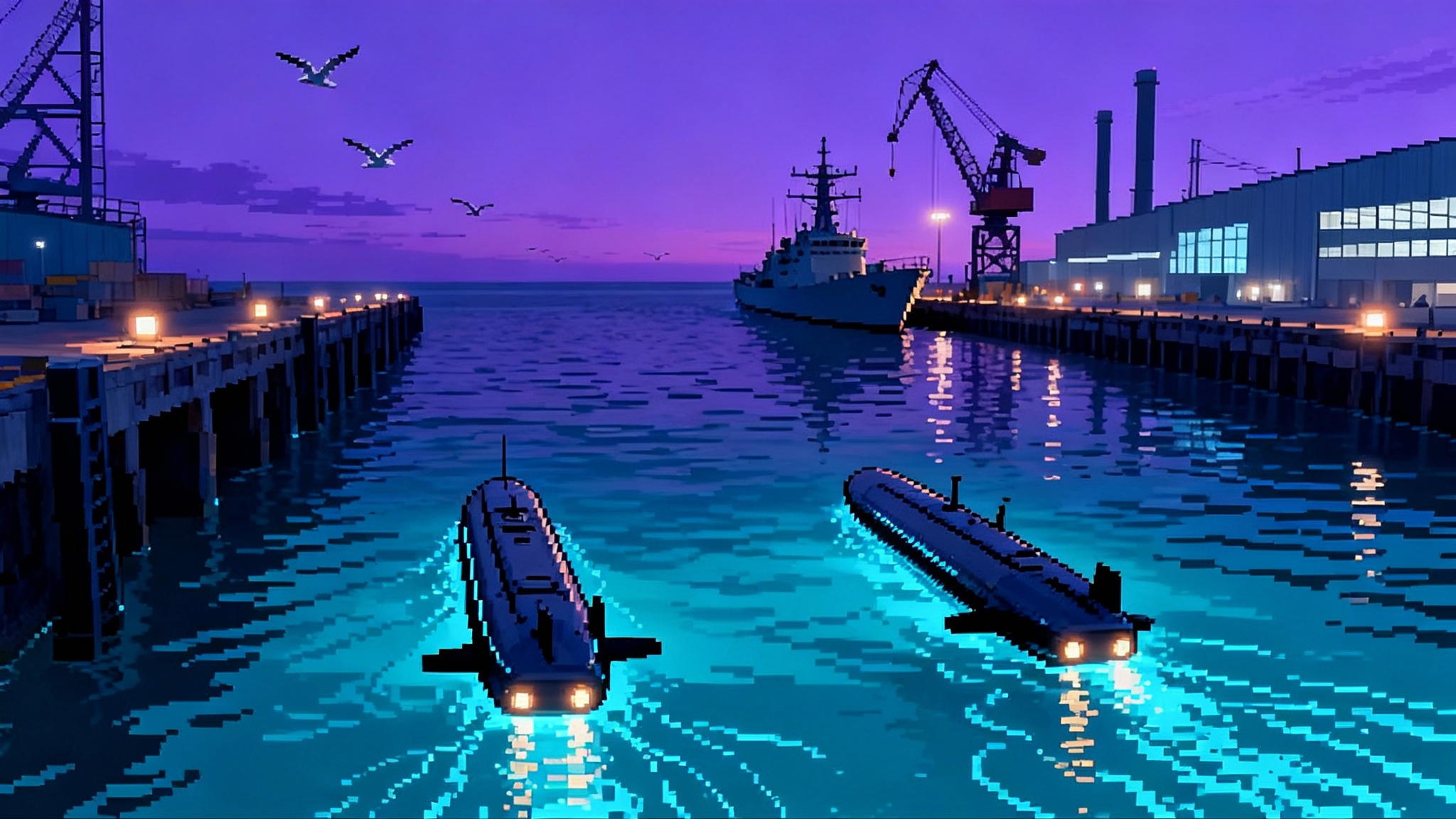
On September 10, 2025, Australia crossed a line that many navies have discussed but not yet reached. The government signed a five-year, 1.7 billion Australian dollars (AUD) contract to produce a fleet of Ghost Shark extra large autonomous undersea vehicles, turning a fast-moving research effort into a standing program for the Royal Australian Navy. Officials described delivery, sustainment, and continued development inside the same deal, and said the number of vehicles would be in the dozens. The announcement confirmed that the first operational Ghost Sharks will enter service in early 2026, a pace more familiar to smartphones than submarines. This decision gives the Indo-Pacific its first production fleet of this class of autonomous undersea system, and it sets a practical template for how allies can field similar capabilities. The Australian Defence Ministers explained the scope and intent in their official release: Australian ministers' Ghost Shark release.
If you think of a conventional submarine as a powered aircraft carrier of the deep, think of Ghost Shark as a long-range electric glider with muscle, built to cruise quietly for weeks and show up exactly where it can change an opponent’s calculus. It is not a toy. It is an extra large autonomous undersea vehicle, often shortened to XL-AUV, which means a hull large enough to carry serious range, sensors, and modular payloads without a crew on board.
What makes an XL-AUV different
An XL-AUV combines three traits that used to be mutually exclusive: size, range, and cost. Traditional submarines offer size and range, but they are expensive to buy and crew. Small robotic craft are affordable, but they lack the legs and payload volume to matter at theater scale. XL-AUVs sit in the middle. They deliver long-range operations with payload flexibility, but at a price and production tempo that allow for mass. Mass is the point. When a fleet can field dozens of autonomous vehicles, commanders can create new patterns of presence and pressure.
Ghost Shark, built by Anduril Australia with a supply chain of more than 40 domestic firms, is the first of these vehicles to move from prototypes to a production fleet in the Indo-Pacific. Public details are limited by design, but the mission categories are clear: intelligence, surveillance, reconnaissance, and strike. That combination unlocks a toolkit that ranges from scouting ahead of crewed submarines to holding high-value targets at risk in contested areas. As part of the government’s announcement, officials said the program would support hundreds of jobs and maintain a sovereign industrial base around autonomy and undersea systems. Reuters summarized the scale and timeline succinctly, including the early 2026 service date: Reuters on Ghost Shark deal.
Why this matters for undersea deterrence
Deterrence works when an adversary cannot find a clean answer to the question, “Can I get away with this?” Ghost Shark muddies that answer in three specific ways.
First, it expands the surveillance envelope. A crewed submarine can be in only one place at a time. A fleet of XL-AUVs allows a navy to maintain multiple persistent picket lines across choke points and sea lanes. Imagine a quiet, moving tripwire from the Lombok Strait to the Philippine Sea, with each vehicle listening, classifying, and reporting back through satellite gateways or occasional periscope-height data bursts. The opponent now has to assume that someone is always listening.
Second, it raises the cost of hunting. Finding a crewed submarine is worth the effort because the payoff is large. Hunting a swarm of unmanned vehicles is wasteful. Even if an opponent disables one Ghost Shark, many more remain at sea, and the production line can replace losses quickly. This shifts the economics of undersea warfare from bespoke platforms toward an attrition-tolerant model.
Third, it enables controlled ambiguity about strike. The payload specifics are not public, but the government has been explicit about strike as a mission. In deterrence terms, that creates uncertainty about whether a given XL-AUV is a sensor, a decoy, a minefield mapper, or a weapon carrier. A prudent adversary must treat each contact as potentially dangerous, which slows operations and complicates planning.
Sea denial, explained simply
Sea denial is the art of making parts of the ocean too risky for an adversary to use freely. Traditionally that has meant mines, submarines, and air power working in combination. XL-AUVs add a new layer that is patient and persistent. Here is how Ghost Shark can plug into sea denial without revealing classified details.
- Pickets and patrols: Vehicles can form overlapping patrol boxes around key straits and ports. They can detect patterns, such as repeated tug and barge movements that indicate logistics runs, and flag anomalies that merit closer inspection by crewed assets.
- Route sanitization: Before a carrier or amphibious group transits, a pack of XL-AUVs can sweep the intended path for threats, confirm acoustic conditions, and leave behind temporary sensors that continue to report after the main body passes.
- Pressure on logistics: By cueing allied aircraft or surface vessels, XL-AUVs can turn interdiction into a rhythm. The vehicles act as distributed scouts that never tire, handing targets to shooters that can arrive hours later.
- Persistent deception: Some vehicles can carry payloads that create acoustic or electromagnetic signatures to mislead an adversary. The uncertainty forces wider defensive screens and burns precious fuel and time.
The result is not a wall. It is a living minefield of perception, where an adversary must assume that surveillance and response are closer than they appear.
The kill web gets a hull upgrade
Many readers will know the term kill chain, the linear sequence from find to fix to finish. The modern concept is the kill web, where sensors and shooters connect across services and allies. XL-AUVs strengthen the web in places it has been thin: undersea and inside denied areas. For surface and strike integration context, see Tomahawk-era kill web integration.
A Ghost Shark can be the first node in a chain that ends with an allied aircraft or coastal missile battery. It can also be a last-mile node, holding a threat at risk long enough for a strike platform to close. Because the vehicle is unmanned, it can take paths and dwell in areas that crewed ships avoid. The key is interoperability. Data formats, control interfaces, and tasking must be standardized so that a vehicle cued by an Australian controller can pass a track to a Japanese maritime patrol aircraft or a United States surface combatant without translation delays.
The payoffs are concrete. Consider a scenario where a Chinese surface action group sorties into the Philippine Sea. A dispersed set of Ghost Sharks has been listening along probable axes of advance for weeks. One vehicle detects changes in background noise consistent with a large formation displacing water. It streams compressed acoustic features through a burst transmission. Ashore, a fusion cell promotes the detection to a track. A Japanese aircraft receives the cue and drops sonobuoys to localize. A United States destroyer adjusts its course by 80 nautical miles to set up a long-range engagement if required. At no point did a crewed submarine have to sprint from far away. The undersea layer fed the kill web instead of being a separate, exquisite asset.
A production playbook, not a science project
The striking part of the Australian decision is the clock. The original collaboration between the Royal Australian Navy, the Defence Science and Technology Group’s accelerator, and Anduril began in 2022. By 2025, the government put real money and real quantities on contract. That is rare in defense. More important, the contract is designed to keep learning while building. It bundles delivery, maintenance, and continued development, so that every field cycle can feed the next production batch.
This is a playbook others can reuse:
- Keep the vehicle simple, and make payloads modular. The hull should be boring in the best way: reliable, repairable, and repeatable. The mission modules should handle variety. That is how you build many units and still adapt to new missions.
- Put factory and fleet close together. The Australian facility is in New South Wales, with access to test ranges and naval operators. Engineers can watch vehicles launch on Monday and adjust code by Friday. For a parallel in rapid autonomy adoption, see uncrewed fighters race begins.
- Fund the spiral, not only the unit. A five-year line that pays for iterative development reduces the temptation to freeze designs too early.
- Protect interfaces, not proprietary lock-in. If allies can plug their own payloads and control software into common physical and data interfaces, the fleet will grow faster. Sovereign control should live in what you load and how you use it, not in a unique hull that only one vendor can touch.
How the United States and partners plug in by 2026
Australia’s move creates an option for allies starting next year. Here is a practical roadmap that countries can follow without waiting for a headline-grabbing joint program.
- Agree on a minimum interoperable package. Define an undersea message set, control handshakes, and encryption profiles that fit within existing allied networks. Keep it narrow, like a starter vocabulary. The point is to pass a track with confidence, not to rewrite every standard at once.
- Share a starter mission set. Pick two missions for combined use in 2026: long-range trail of high-value targets and harbor approach monitoring. Publish the tactics, techniques, and procedures for these two tasks and exercise them at scale.
- Use existing exercises as forcing functions. RIMPAC 2026 offers real geography, varied water conditions, and multiple navies. Put XL-AUV detachments in the water for the full duration. Judge success by the number of clean handoffs between vehicles and shooters.
- Bring your own payload. Let each navy contribute at least one homegrown sensor or effect. The shared hulls carry a mix. That accelerates national industries while keeping the fleet coherent.
- Buy time with autonomy levels. Operators should not wait for perfect autonomy. Start with conservative behaviors in 2026, such as preplanned tracks and supervised autonomy, then increase decision authority as confidence grows.
The counters, and what to do about them
No new capability arrives without a response. Adversaries will try to detect, deceive, and disable XL-AUVs. Here are the most likely counters, and how to blunt them in practical ways.
- Broad-area acoustic search: Large distributed arrays and low-frequency active sonar can sweep for slow movers. Response: diversify signatures. Produce multiple propulsor and hull variants, even within the same batch, to force the adversary to hunt a family of sounds rather than a single pattern. Use wake-hiding maneuvers when crossing known sensor lines.
- Close-in seabed defense: Nets, trip lines, and stationary interceptors near ports. Response: limit exposure by using XL-AUVs for the last mile only when it matters. Use smaller expendable vehicles for terminal approaches and keep Ghost Sharks as the high-end scouts and couriers.
- Communications interdiction: Jamming or spoofing of satellite burst channels. Response: treat communications as a rationed commodity. Use short, authenticated bursts on diverse paths, and switch to opportunistic data mules if needed, where one vehicle physically passes near another to exchange information. For resilient navigation and timing in contested environments, track progress in quantum PNT for GPS-proof nav.
- Legal and narrative attacks: Claims that autonomous strike is reckless. Response: be transparent about command authority and arming rules. Demonstrate human-on-the-loop control for strike payloads, with logged decision paths and a clear audit trail.
Cost, mass, and the new math of presence
A core change with XL-AUVs is the relationship between cost and presence. A single crewed submarine can create presence over a wide area, but it is a scarce asset that must be managed carefully. A dozen XL-AUVs can create constant presence in multiple locations at once. If a commander can afford to place three vehicles on station for every chokepoint of interest, the operational picture becomes sticky. Tracks are maintained over longer windows. Adversaries must accept risk earlier in their voyages. The rhythm of the theater changes from episodic to continuous.
This matters because deterrence is about rhythm. When sensors are always present and handoffs are routine, the burden shifts to the adversary to hide, to delay, and to burn fuel and time. Those are costs that do not show up on a budget line but which decide outcomes at sea.
What success will look like by late 2026
It is easy to assume that a breakthrough needs a dramatic first use to count. The better test for Ghost Shark is quieter.
- Reliable, boring sorties: Vehicles launch, patrol, report, recover, and repeat without drama. The most powerful proof point is a high sortie completion rate.
- Clean handoffs in the kill web: Acoustic detections flow to air and surface shooters with minimal delay. Everyone knows the playbook and executes it.
- A living backlog: Operators and engineers maintain a shared queue of issues and features, with fixes shipping monthly into the fleet. Hardware changes are minor, software changes are frequent.
- Multi-nation detachments: By the end of 2026, at least two allied navies should have flown payloads or run missions on Australian-built hulls, using the common interfaces agreed earlier in the year.
What to watch next
- Payload disclosure: Without revealing secrets, expect hints about non-kinetic payloads such as deception and electronic support. Those often deliver outsized effects early.
- Training pipelines: Schools will start qualifying sailors as autonomous undersea vehicle mission commanders. The curriculum will shape doctrine.
- Export contours: Expect an initial focus on close allies with compatible security frameworks. The trick will be to export enough capability to matter while protecting the parts that make Ghost Shark hard to copy.
The bottom line
Australia just put a production line behind a capability most navies have only prototyped. The combination of long-range autonomy, modular payloads, and a manufacturing base that learns while it builds will change how undersea power is projected in the Indo-Pacific. Ghost Shark will not replace crewed submarines, but it will let them be in two places at once, by saving their time for the missions only they can do and letting autonomous vehicles hold ground everywhere else.
For the United States and partners, the playbook starts now. Keep the vehicle simple and the payloads modular. Standardize a narrow set of interfaces. Exercise in the real ocean for months, not days. Share two missions and get very good at them. If allies do those specific things in 2026, the result will not be a headline. It will be a habit that holds the line under the sea.