From Dots to Weathered Worlds: Webb’s 2025 Exoplanet Turn
In 2025 JWST delivered two breakthroughs: direct imaging of a Saturn-mass planet and the first 3D eclipse map of an alien atmosphere. Here is why that matters and what comes next.

The year exoplanets became places
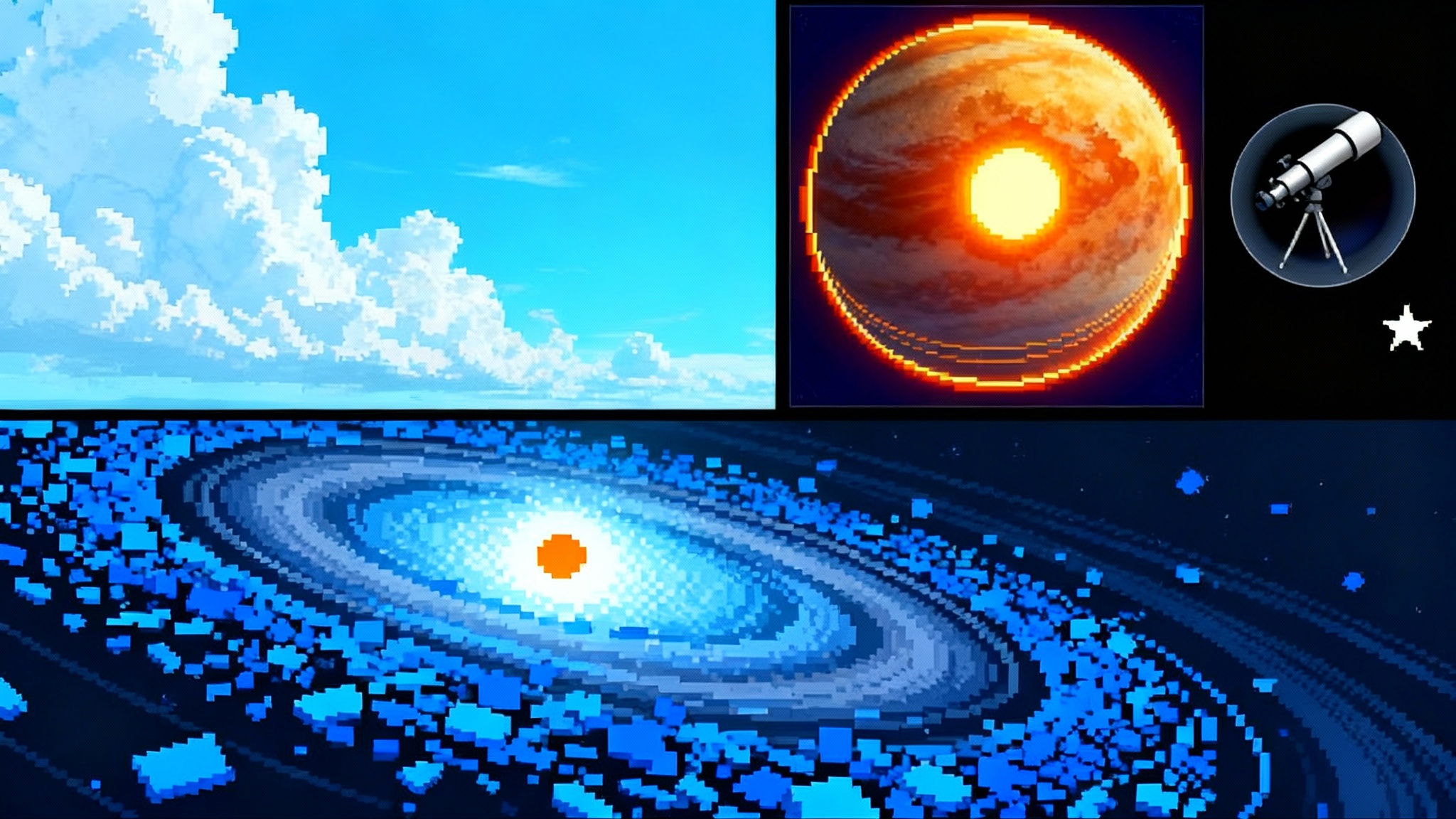
For three decades, exoplanets were mostly hints in data. A dip in starlight meant a transit. A wobble in stellar spectra meant a tug from a hidden companion. We had numbers on mass and radius, plus a few postcard images of giant worlds seen far from their stars. In 2025 that changed. Between June and November, two results pushed exoplanets from “dots” to “places.”
First came a direct discovery with the James Webb Space Telescope (JWST), announced on June 25. Using a coronagraph on Webb’s Mid-Infrared Instrument, a team imaged a Saturn-mass object orbiting the young star TWA 7 and published the result in Nature. NASA described the detection as compelling evidence of a planet and noted that confirmation work is ongoing. The practical meaning is clear. JWST, designed as a general observatory, just found a new planet by blocking starlight and revealing the faint glow beside it. That is a capability jump, and a proof that coronagraphy on a space telescope can reach down to lower planet masses than we had seen before. NASA mission note on TWA 7 lays out the core facts and the caution.
Then, on October 28, astronomers unveiled the first three-dimensional map of an exoplanet atmosphere. The target was WASP-18 b, an ultra-hot Jupiter that orbits its star in less than a day. By watching the planet slip behind the star, color by color, researchers used eclipse mapping to reconstruct how temperature changes with latitude, longitude, and altitude. The paper shows a bright central hotspot, a cooler ring around the limbs, and signs that water molecules are torn apart in the hottest zone. It is the planetary equivalent of lifting a foggy silhouette into a living weather map. The team’s Nature Astronomy paper describes the method and what the 3D structure implies about winds and chemistry. See the Nature Astronomy WASP-18 b study for the technical details.
These two steps are different in technique but similar in impact. Coronagraphy turns the glare down so a planet is visible next to its star. Spectroscopic eclipse mapping turns a single pixel of light into a layered, regional map. Together they move the field from detection to diagnosis.
What coronagraphy did differently in 2025
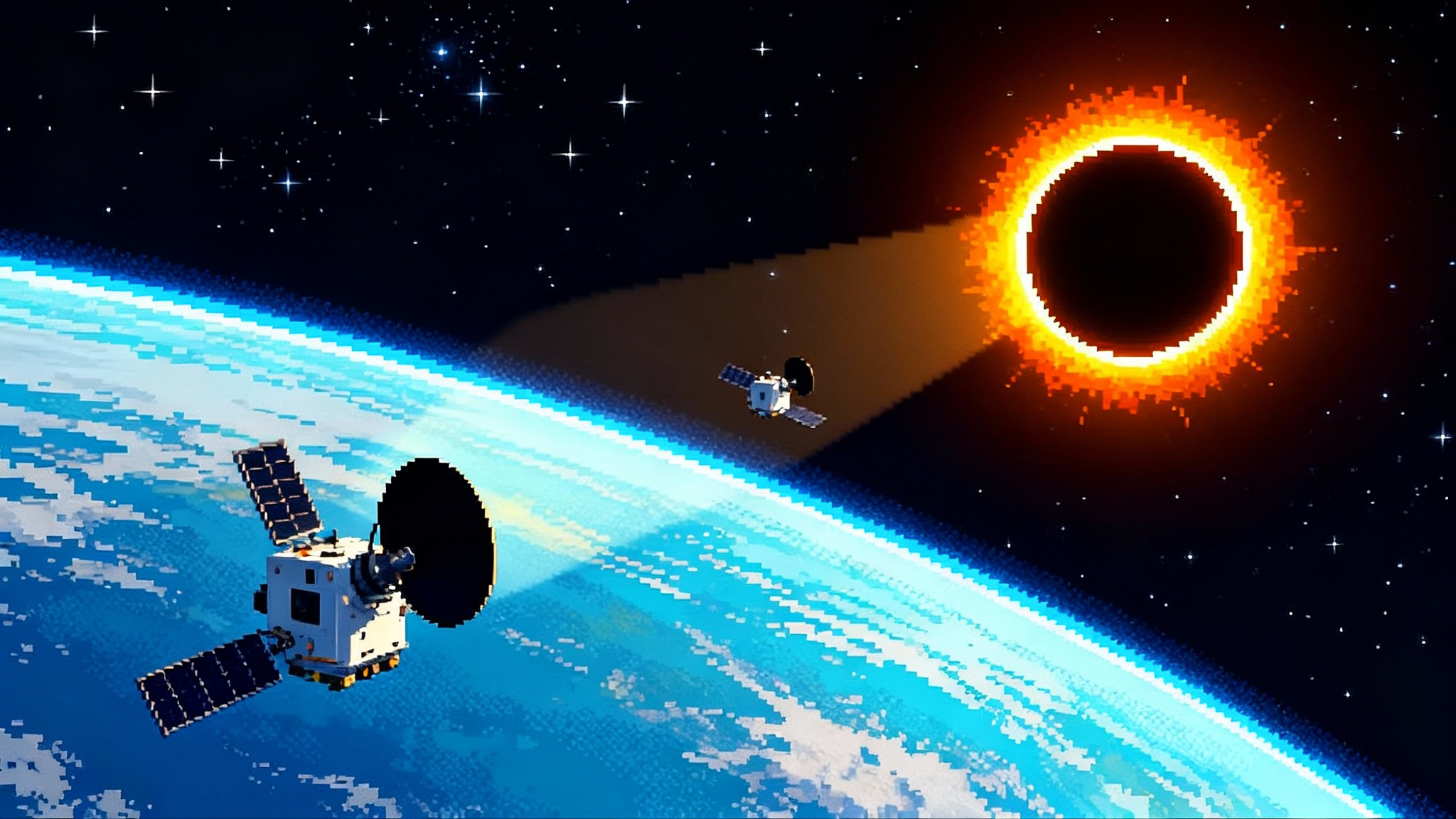
A coronagraph is a star-shade inside the telescope. It masks starlight and cleans up the optical path so that nearby faint light can be seen. On JWST, this is done with precisely machined masks and active control of the wavefront. Observers aim at stars that are young and nearby because young giant planets still glow in the infrared from the heat of formation. When JWST pointed at TWA 7, it saw a compact reddish source embedded in a debris disk. The source’s position and brightness matched the kind of shepherding planet that could sculpt that disk into rings. The estimated separation is dozens of times the Earth Sun distance, which gives the coronagraph room to operate.
Coronagraphy is a numbers game. The background star is millions to billions of times brighter than the planet. The telescope needs a certain inner working angle, which is the smallest separation where it can cancel enough starlight to see something beside it. The instrument also needs contrast, which is how deeply the starlight is suppressed compared to the planet’s light. JWST’s mid infrared coronagraph gives up some angular sharpness compared to visible light, but gains sensitivity to the warm glow of young, low mass planets. That is how a Saturn mass world was picked out. The next concrete step is obvious. Confirm the orbit, refine the mass, and take spectra that test for methane, water, and carbon monoxide. Those measurements will separate a true planet from any exotic disk clump and will tell us how the atmosphere is built. For a formation-flying space coronagraph pathfinder, see the Proba-3 formation-flying coronagraph.
What 3D eclipse mapping changed
Before 2025, phase curves and eclipse maps gave us two dimensional snapshots of hot Jupiter daysides. The new result goes further by slicing the light into many wavelengths and tying each slice to a different atmospheric depth. That turns a flat map into a profile with layers. In WASP-18 b, the analysis reveals a temperature inversion near the substellar point, consistent with the presence of optical absorbers that heat the upper atmosphere, and a cooler annulus toward the limbs. Crucially, the water signal is weaker in the hottest zone, as expected where high temperatures split water into hydrogen and oxygen. That is not a guess. It is the kind of process-level physics you can only see when you control for both location and altitude. For broader spectral context across the sky, explore SPHEREx’s all-sky engine of discovery.
Why does this matter for the rest of exoplanet science? Because it proves we can do weather, not just climate. A world that was once a single data point now has distinct regions with different chemistry and winds. That enables real tests of circulation models. It also sets a standard. If an ultra-hot Jupiter can be mapped in 3D from eclipse spectroscopy, then a slightly cooler hot Jupiter can be mapped too, and then a warm Neptune, and one day a temperate super Earth. The signal gets fainter as you go smaller and cooler, but the method does not change. What changes is how long you integrate and how carefully you control the systematics.
Coronagraphy and eclipse mapping make a one two punch
Think of coronagraphy and eclipse mapping as complementary senses. The coronagraph sees planets that do not transit and often sit far from their stars. Those are prime candidates for follow up with spectroscopy to learn composition and clouds. Eclipse mapping acts on transiting systems, where geometry provides an eclipse. Those systems are typically closer in and hotter, which makes their daysides glow brightly in the infrared. Coronagraphy expands the census. Eclipse mapping deepens the dossiers.
The practical synergy is already in motion. The TWA 7 imaging result points to a population of Saturn mass and lighter planets around nearby young stars that are within reach of JWST’s coronagraph and spectroscopy. The WASP-18 b 3D map shows how to convert brightness changes into structured atmospheres. Looking ahead, teams will combine the two modes. For directly imaged planets with favorable orbits, they will chase partial phase curves to add longitudinal information. For transiting warm Neptunes where coronagraphy cannot resolve the planet from its star, they will push eclipse mapping to cooler temperatures and subtler spectral features.
What happens next in JWST Cycles 4 to 6
Selection results for Cycle 4 in March 2025 and the open Call for Cycle 5 in August 2025 foreshadow a busy queue of exoplanet programs. Expect three concrete threads in the next two years.
-
Confirmation and characterization of JWST’s directly discovered planet. Teams will revisit TWA 7 to re image the source and measure common proper motion, then obtain low resolution spectra to pin down temperature and composition. If the object shares the star’s motion and sits where dynamical models expect, the case for a planet will be closed. The how is straightforward. Use the same coronagraph mask and orientation, repeat the observation months apart, and compare the source’s motion to the star’s parallax and proper motion.
-
A survey push on young, nearby stars. Now that a Saturn mass planet has been seen, the bar for target selection moves. Programs will favor disks with rings and gaps that hint at shepherd planets. They will also bias toward stars where JWST’s inner working angle lines up with the expected planet separation. The point is not only to count planets, but to feed the pipeline with promising targets for next generation direct imaging.
-
Deeper and cooler eclipse maps. Researchers will extend spectroscopic eclipse mapping beyond ultra-hot Jupiters. The immediate test cases are very hot Jupiters and warm Neptunes with strong water and carbon monoxide features. These systems require longer integrations and very careful control of instrument systematics, but the recipe is now public and reproducible. The payoff is sensitivity to vertical temperature gradients and clouds, which are the keys to understanding heat transport and chemistry on these worlds. For how wide-field mapping can reset a field, see Euclid’s first open map release.
Roman’s coronagraph will be a reality check in 2027
The Nancy Grace Roman Space Telescope is scheduled to launch no later than May 2027. It will carry the most advanced space coronagraph yet flown as a technology demonstration. The Roman coronagraph is designed for active wavefront control and very high contrast in visible light. It will not spend the majority of its mission on coronagraphy, and it is not a life finding machine, but it will do two important things for exoplanets. First, it will image mature giant planets in reflected light around nearby stars, a different regime from JWST’s young self luminous targets. Second, it will prove that active, space based coronagraphy can hold the stability needed for future flagships to chase Earth like planets around Sun like stars.
Think of Roman as a flight test for the control system that a life finding mission will need. The action item for the community is to use Roman’s tech demo to harden the observing strategies, post processing, and calibrations that squeeze out every factor of ten in contrast. That is the bridge from imaging bright Jupiters to seeing pale blue dots.
The Extremely Large Telescopes will close the gap from the ground
On the ground, the European Southern Observatory’s Extremely Large Telescope, the Giant Magellan Telescope, and the Thirty Meter Telescope were designed with exoplanets in mind. The timelines vary, but the direction is consistent. With apertures of 25 to 39 meters and extreme adaptive optics, these observatories will sharpen coronagraphy at small angles and longer wavelengths. That matters because cool Neptunes and super Earths emit strongly in the thermal infrared. Instruments like METIS on the ELT and the planned high contrast imagers on GMT will try to detect the thermal glow of nearby small planets and take low resolution spectra.
Here is the near term sprint these facilities set up. JWST proves that space coronagraphy can find lower mass planets and that 3D eclipse mapping can diagnose weather and chemistry. Roman pushes stable, visible light coronagraphy and teaches the discipline of high contrast operations in space. The ELT class telescopes pick off the nearest cool Neptunes and super Earths in the infrared, especially around small, nearby stars. Each piece adds different wavelengths, contrasts, and angles. Together they collapse the gap between hot giant maps and the first looks at temperate super Earths.
What this means for the next five years
- Expect catalogs of directly imaged planets to add cooler, lower mass members. The method is targeted, not random. Focus on young, nearby stars with structured disks and separations that match JWST’s masks.
- Expect the first family of 3D maps. Researchers will apply spectroscopic eclipse mapping to more hot Jupiters and the warm Neptune regime. The early goal is to calibrate the connection between stellar heating, winds, and chemistry across planet types. The test is whether models that fit one world can predict another without re tuning every knob.
- Expect handoffs across facilities. JWST will hand candidates to Roman for reflected light checks. Roman and ground based extreme adaptive optics will hand back targets that need mid infrared spectra only JWST can provide. Scheduling and data pipelines will matter as much as raw photons.
- Expect sharper questions. When does water dissociation start to matter globally. Where do clouds trap heat versus simply mute spectral lines. Which disks produce Saturn mass planets at tens of astronomical units, and which do not. These are mechanism questions, not just catalog additions.
What to do now
If you work on proposals, aim for programs that close the loop between detection and diagnosis. Coronagraphy plus follow up spectroscopy. Eclipse mapping plus circulation modeling. If you build tools, invest in wavefront control simulations and time series systematics removal. If you build instruments, target inner working angle at the separations expected for warm Neptunes within 10 to 20 parsecs, and design for stability over the many hour integrations that eclipse mapping needs.
For everyone else who simply wants to know if we will ever see the weather on a temperate super Earth, 2025 offered a sober reason to be optimistic. We watched a space telescope find a new planet beside its star. We watched another team turn a single pixel of light into a layered, regional weather map. That is not a finish line, but it is the right slope. Keep following the line and it points straight to images and maps of cooler Neptunes first, then temperate super Earths around the nearest small stars. The techniques are in hand. The hardware is coming online. The work now is to push contrast, push calibration, and keep picking the right targets.
A clear endgame, without hype
In the end, breakthroughs stick when they change what is routine. Coronagraphy and eclipse mapping did that in 2025. They took us from mere detection to diagnosis. They opened a path where every new world is not just counted, but characterized in three dimensions. That is how dots become weathered worlds, and how a field moves from discovery to understanding.